Writing · 7 min read
The 30-second script, written once and reused forever
A 30-second short-form script has six parts: a hook in the first two seconds, the stakes by second six, three or four beats that each earn the next, a turn the viewer did not expect, proof woven through, and a one-line close. Write it to be spoken, read it aloud once, and write the caption last.
Most brand videos fail before the camera turns on, because there was no script — or because the script was a caption with ambitions. A short-form script isn't prose. It's a sequence of beats, each of which earns the next, ending somewhere the viewer didn't expect to end up.
This guide gives you one structure that covers nearly every brand format, a worked example for every part of it, the mistakes that make scripts feel like ads, and a session that produces a month of scripts in a single sitting.
How short-form scripts are different
Written to be heard, not read
Short sentences, contractions, the words you'd use across a table. Read every script aloud once before you keep it. Anything that sounds like a website stays on the website.
Every line earns the next
There is no paragraph a viewer will sit through for the good part later. Each beat has to create the small question the next beat answers. If a line can be cut without breaking that chain, cut it.
One idea, told twice
Thirty seconds fits one idea. The strongest scripts say it once as a claim and once as a demonstration. Two ideas in one script produce a video about nothing.
The close is not a call to action
End on the sharpest line, a question, or the result — not on 'follow for more'. The viewer decides whether to follow during the video, not because you asked at the end.
The structure, beat by beat
Hook, seconds 0–2
One line that stops the thumb and sets up a specific expectation. Text on screen, spoken aloud, first frame matching. Everything in the hooks playbook applies here; in the script it's a single line at the top, nothing else.
Example
"Our first forty TikToks averaged 300 views. Here's the script change that fixed it." That's the whole hook. No 'so', no 'today we're going to'.
Watch out
Warming up. Any sentence before the hook — a greeting, a 'quick one', context — is the video failing. The script starts on the hook or it doesn't start.
Stakes, seconds 2–6
Why this matters to the viewer, in one or two lines, in their terms. Not why it matters to you. Stakes convert curiosity into attention: the viewer now has a reason to stay beyond 'I wonder'.
Example
"If you're posting three times a week and nothing moves, it's probably not the content — it's the first six seconds of every script."
Watch out
Stakes that are really features. 'Because our tool does X' is not a stake. A stake is something the viewer loses or gains, stated as their problem.
Beats, seconds 6–22
Two or three concrete points, each one sentence of voiceover and one visual change. Number them on screen if there are three. Each beat should be usable on its own; together they should feel like they add up to the hook's promise.
Example
"One: we moved the product to second eight. Two: we cut every sentence that started with 'we'. Three: we ended on the number, not the logo." Three visual cuts, three text cards.
Watch out
Beats that repeat. Three ways of saying the same thing is one beat padded. If you can't find three distinct points, write a 20-second video with two.
Turn, seconds 22–26
The moment the video becomes worth sharing: the counterintuitive bit, the reveal, the thing the beats were building to. Not every format needs a turn, but the ones that get shared almost always have one.
Example
"And the video that finally worked? It was the same script as video twelve. We just cut the first four seconds off it."
Watch out
A turn that's a twist for its own sake. It has to be true and it has to follow from the beats. A manufactured reveal costs more trust than a flat ending.
Proof, woven through
Not a section — a habit. Every claim in the script gets a visual receipt as it's said: the screenshot, the number, the product doing the thing. Proof is why the same script sounds honest from one account and salesy from another.
Example
When the voice says '300 views', the analytics screenshot is on screen. When it says 'the fix', the before and after scripts are side by side. The viewer never has to take your word for it.
Watch out
Saving proof for the end. By then the sceptical viewer left. Attach proof to the claim at the moment the claim is made.
Close, seconds 26–30
One line. The sharpest restatement, a question the viewer will answer in the comments, or the result held on screen. The video should feel finished, not stopped — and it should not end on a request.
Example
"Same product. Same footage. Four seconds shorter. Which four seconds is your script wasting?" Hold on the final frame for a beat.
Watch out
'Follow for more tips like this.' It signals the content is over, it's the line everyone skips, and it turns a video into an ad in its last two seconds.
Caption, written last
The caption is not the script. It's the second hook for people who paused, a place for the one keyword you want to rank for, and three to five specific hashtags. Write it after the video is cut, so it matches what's actually on screen.
Example
"the script change that took us from 300 views to 80k. full breakdown in the video. #tiktokforbrands #shortformscript #smallbusinesstiktok"
Watch out
Retelling the video in the caption. If the caption gives the answer, nobody needs to watch. Tease, don't summarize.
The read-aloud pass
The step that separates scripts that work from scripts that look fine. Read the whole thing aloud, at speed, with a timer. Cut anything you stumble on, anything over thirty seconds, and anything you'd never say to a person.
Example
A 38-second read comes down to 29 by cutting two 'actually's, one 'so', a sentence that repeated the hook, and the word 'leverage'.
Watch out
Reading it in your head. Your head skips the awkward parts. Your mouth doesn't.
Why scripts sound like ads
The 'we' script
Count the sentences that start with 'we' or the product name. More than one in thirty seconds and the video is about you. Rewrite them to start with 'you' or with the situation.
Feature lists
'It also does X, Y and Z' is a spec sheet read aloud. One feature, shown solving one problem, beats three features named.
Website vocabulary
Seamless, leverage, empower, solution, streamline. If the word has never been said out loud by a customer, it doesn't belong in a script.
No ending
Scripts that trail off into a CTA never feel finished, and unfinished videos don't get rewatched or shared. Write the last line first if you have to.
A batch-scripting session
- Minutes 0–15
Pick twelve hooks from your hook session or your comments. One per video. Assign each a format from the video ideas playbook.
- Minutes 15–60
Write beats only: for each video, the two or three points and the visual for each. Bullet points, no prose. Skip anything you get stuck on and come back.
- Minutes 60–90
Add stakes and closes. One line each. The close should be writeable in under a minute if the beats are right; if it isn't, the beats aren't.
- Minutes 90–110
Read every script aloud with a timer. Cut to thirty seconds. Note which lines need a visual receipt you don't have yet.
- Minutes 110–120
Write the captions. Twelve scripts, shoot-ready, with a shot list of receipts to capture. That's the month.
Script FAQ
How many words is a 30-second script?
Roughly 70 to 85 spoken words at a natural pace. If you're past 90, something has to go — and it's usually the second sentence of the stakes or a beat that repeats another.
Do I need a script for every video?
For brand accounts, yes — even the 'candid' ones. A script can be five bullet points. What it can't be is nothing, because nothing is where the greeting, the ramble and the feature list come from.
What if my product needs more than 30 seconds to explain?
Then the video isn't explaining the product; it's explaining one thing the product does. Split it. A series of 30-second videos each answering one question outperforms one 90-second overview every time.
Can AI write these?
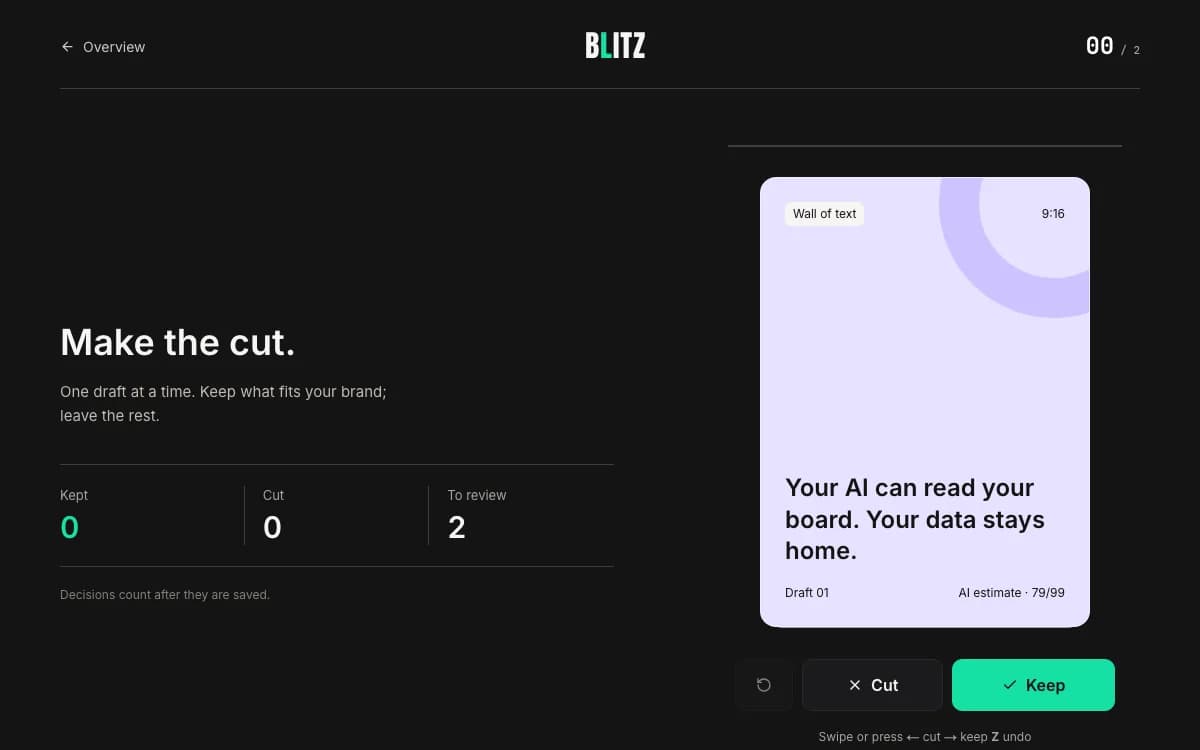
AI can draft beats and hooks fast enough to make batching trivial — that's what Spoolt does with your site. What it can't do is the read-aloud pass or the keep/cut decision. Those stay human, and they're the part that makes the script yours.
One structure, learned once, then reused for every video: hook, stakes, beats, turn, close, proof throughout. It isn't a formula for creativity — it's the scaffolding that lets the creative part happen in the beats instead of being spent on figuring out how to start.
Want these written in your brand's voice? Paste your website or App Store link and Spoolt turns ideas like these into a month of scripted short-form — triage in Blitz, schedule to TikTok. Free to try, no card.
← All playbooks